News
May 21, 2026 - Here is Why Helicopter Operators Are Stockpiling Critical Spare Parts in 2026

Helicopter operators in 2026 are shifting away from their long-standing reliance on just-in-time inventory. Previously, operators trusted the efficiency of aviation supply chains to prevent service interruptions, which was a strategy that worked well when logistics were stable and replacement parts were consistently available.
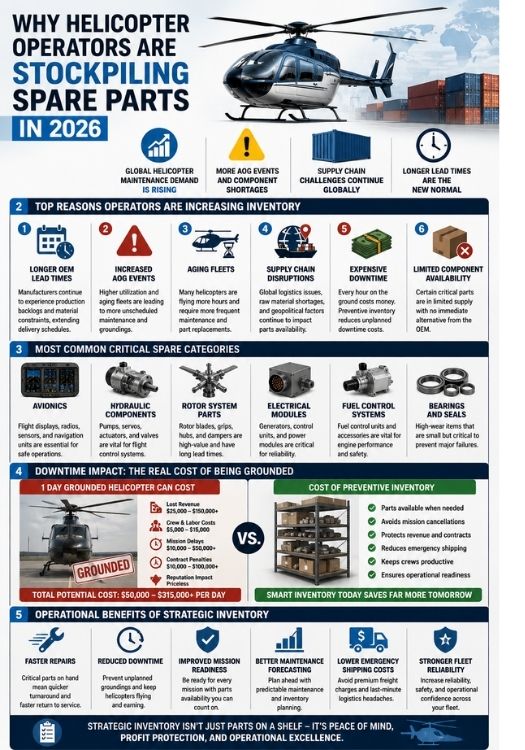
That landscape has shifted. Across sectors such as EMS aviation, offshore transport, law enforcement, utility services, tourism, firefighting, and private fleet operations, helicopter operators are steadily raising their stock of essential spare parts. Some are developing in-house inventory programs for the first time, while others are significantly strengthening existing stock strategies after experiencing costly AOG events in recent years.
The reasoning is straightforward: aircraft downtime now costs more than holding inventory.
When a helicopter is grounded, the impact can be substantial. It may slow emergency medical response, delay offshore personnel movements, disrupt utility work, push back maintenance schedules, jeopardize contract commitments, and trigger operational losses that reach well beyond the failed part itself.
Meanwhile, operators are also dealing with extended lead times, older aircraft fleets, rising demand for components, and continued uncertainty surrounding the reliability of global supply chains.
The aviation industry is undergoing a clear, measurable transformation. Rather than waiting for components to fail before sourcing replacements, operators are now preparing in advance. For fleet managers, maintenance directors, procurement teams, and those responsible for keeping aircraft operational, inventory planning has evolved from a routine financial task into a core operational priority.
One of the biggest drivers behind this change is the growing uncertainty about whether parts will remain available. Parts that once could be delivered in days now can take weeks or even months, depending on the type of aircraft and applicable certification requirements. Operators managing Bell, Airbus, Leonardo, Sikorsky, and Robinson fleets have all encountered delays stemming from manufacturing backlogs, shipping disruptions, labour shortages, regulatory reviews, and heightened global demand.
Many operators saw these challenges during periods of widespread supply chain disruption, but they didn’t disappear once the disruptions ended. Instead, procurement teams discovered that ordering supplies as a response to operational issues posed a huge risk, changing the demands of the entire industry
AOG events rapidly highlighted the risks of keeping minimal stock on hand. When a helicopter is unexpectedly grounded, the urgency to secure certified replacement parts can be intense. Maintenance crews frequently find themselves navigating a complex web of vendors, brokers, repair stations, and surplus suppliers, all while ensuring strict adherence to documentation, traceability, and airworthiness standards.
In some situations, operators discovered that the actual repair was straightforward. The real problem was obtaining the part. This has caused many aviation organizations to rethink what qualifies as a critical spare.
In the past, inventory efforts were primarily centred around massive components and items required for planned, scheduled maintenance. Now, operators are expanding those lists to stock seemingly minor parts that could still keep an aircraft grounded if they cannot be sourced quickly.
Examples often include:
-Avionics components
-Hydraulic system parts
-Flight control hardware
-Starter generators
-Fuel control units
-Sensors and switches
-Landing gear components
-Rotor system hardware
-Electrical modules
-Actuators
-Bearings and seals
Even seemingly small components can cause costly delays when unavailable, dramatically increasing costs for EMS operators. Air medical fleets operate in environments where reliability directly impacts emergency response capability - any grounded aircraft could require backup deployment strategies, increased pressure on neighbouring fleets or delayed mission availability - something EMS operators need to bear in mind.
As a result, many EMS operators have increased their shelf inventory programs significantly over the last two years; offshore transport operators also face similar concerns.
Helicopters supporting oil platforms, marine infrastructure and remote industrial sites often operate under stringent scheduling requirements. Any delays in crew transportation schedules can have severe financial repercussions, affecting multiple operational departments simultaneously.
Law enforcement and government aviation teams are likewise strengthening their inventory readiness. Police air units, border patrol operations, and public safety aviation programs often can’t afford extended downtime resulting from parts procurement delays. Because of this, many agencies are prioritizing readily available stock for routine maintenance requirements as well as urgent replacement situations.
Another factor contributing to increased stockpiling is the aging helicopter fleet environment. Many aircraft currently operating worldwide have remained in service far longer than originally expected. Fleet extensions, refurbishment programs, and modernization upgrades have helped operators maximize aircraft value, but aging fleets also create unique supply challenges.
As helicopters age, some parts become increasingly difficult to obtain. Manufacturers may scale back production, discontinue specific components, or concentrate resources on newer aircraft models. In these cases, operators may need to depend on refurbished components, certified surplus parts, or aftermarket sourcing options to keep aircraft mission-ready.
This creates additional urgency around securing reliable inventory before shortages become more severe. And for operators running older Bell platforms or legacy utility aircraft, this issue has become particularly important.
In some cases, procurement teams purchase strategic spare inventory far in advance of immediate need simply because they anticipate future shortages. That would’ve been seen as too cautious a few years ago. Today, many operators see it as responsible planning. Inventory strategy has also been increasingly tied to maintenance forecasting.
With today’s fleet management software, operators can track usage cycles, maintenance intervals, historical failure rates and operational trends more accurately than ever before. Maintenance organizations can spot patterns and stock inventory before critical limits are reached, rather than reacting to failures.
This prediction cuts uncertainty down. It also helps operators avoid panic sourcing in critical AOG situations. The economic case for larger inventory programs has also become easier to make. Operators considered inventory on the shelves as simply tied-up capital for years. Now, many organizations are measuring the cost of downtime in a different way.
A single grounded aircraft may result in:
-Lost revenue
-Delayed contracts
-Crew rescheduling costs
-Customer dissatisfaction
-Emergency shipping fees
-Rental replacement costs
-Increased maintenance overtime
-Operational disruption
When those costs are compared against the expense of maintaining strategic spare inventory, the economics often favour preparation. This does not mean operators are purchasing unlimited inventory. Most organizations are becoming more selective and data-driven about what they stock. The focus is shifting toward mission-critical components with known sourcing risks or historical failure relevance.
Some operators are also building stronger relationships with trusted aviation suppliers and inventory partners. In the past, procurement was often transactional. Today, reliability and responsiveness matter more than ever.
Operators increasingly prefer working with suppliers who understand aviation urgency, maintain traceable certified inventory, and can respond quickly during time-sensitive maintenance situations. Trust has become a major factor. When a helicopter is grounded, procurement teams need confidence that documentation, certifications, and logistics can move quickly without introducing compliance risks.
This has strengthened the importance of knowledgeable aviation inventory specialists and parts support providers. Global logistics complexity is yet another factor pushing operators toward greater preparedness.
Unexpected delays in international shipping, customs processing bottlenecks, export restrictions, and transportation disruptions can all significantly extend repair timelines. Operators who rely entirely on external sourcing leave themselves exposed when supply channels experience slowdowns.
Keeping inventory locally or regionally helps reduce that vulnerability. Across North America in particular, many operators are increasingly prioritizing inventory solutions that offer faster access to parts in order to minimize costly downtime.
The turnaround times for component repairs highlight another crucial shift. As maintenance and overhaul facilities deal with surging demand, the time required to fix, rather than replace, a part is stretching well beyond historical averages.
This dynamic creates a secondary inventory dilemma. Operators frequently need interim "bridge" components to keep their aircraft flying while the original units are in the shop. Without this backup stock readily available, helicopters risk sitting idle on the tarmac for no other reason than waiting for a repair. Furthermore, the rising sophistication of modern avionics systems has introduced yet another layer of complexity to this growing challenge.
Modern helicopter fleets depend heavily on interconnected electronic systems, advanced navigation equipment, digital instrumentation and specialized modules. Some of these components have long repair timelines or narrow production lines. This has emerged as a growing area of focus for operators working to reduce the risk of downtime associated with avionics-related inventory planning.
Insurance and risk management issues are also shaping inventory strategies. Parts availability is now seen by some operators as being part of broader operational continuity planning. The capability to guarantee mission readiness when disruptions strike has become a key business consideration, particularly for organizations supporting emergency services, government contracts or remote operations.
-
The aviation industry has always prioritized safety.
-
Now, operational continuity is becoming equally important.
-
There is also a psychological component to this shift.
Operators that experienced prolonged AOG events during recent years often became far more proactive afterward. Once an organization experiences the financial and operational consequences of waiting weeks for a critical component, inventory planning stops feeling theoretical.
-
It becomes personal.
-
Maintenance directors remember the stress.
-
Flight departments remember the delays.
-
Customers remember interruptions.
-
That experience changes decision-making.
-
Looking ahead, this trend is unlikely to slow down.
Most signs point to helicopter operators continuing to adopt more intelligent inventory strategies in the years ahead. Predictive maintenance systems, data-informed procurement planning, stronger supplier relationships, and strategic parts management are expected to become routine operational standards rather than optional improvements.
Operators are increasingly recognizing that aircraft availability depends on more than maintenance expertise alone; it also requires a resilient and dependable supply chain. Organizations that adjust effectively will be better positioned to achieve higher operational reliability, stronger mission readiness, and lower long-term exposure to downtime.
For aviation operators, the way they think about inventory has changed significantly.
Critical spare parts are no longer considered unnecessary stock sitting on a shelf. Instead, they are being viewed as a form of operational protection. In a helicopter industry where even a single hour of downtime can have serious consequences, preparedness has become one of an operator’s most valuable advantages.